
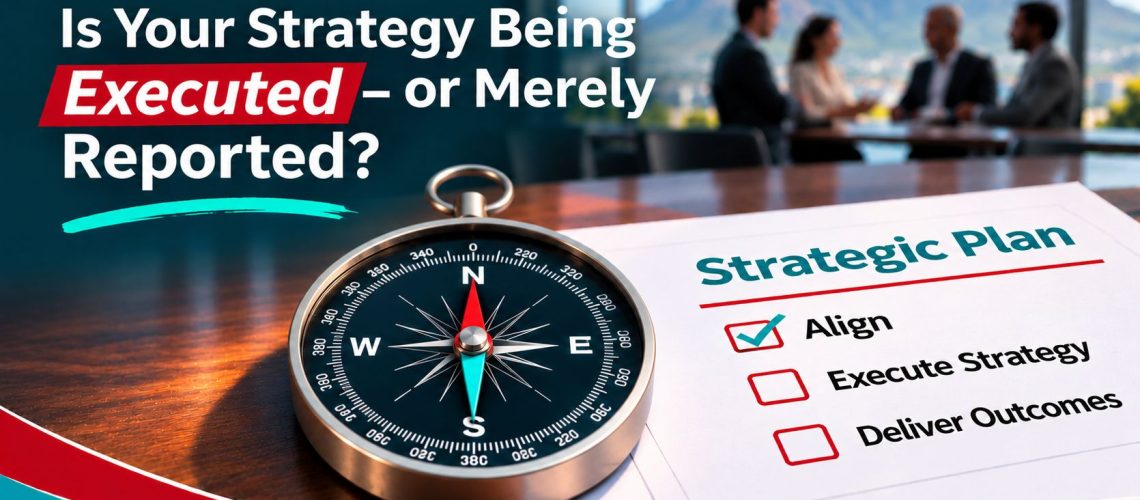

Most organisations do not struggle to produce impressive strategies. They struggle to turn strategic intent into everyday decisions, measurable business outcomes and consistent organisational behaviour. A strategic plan can look convincing in the boardroom while making little difference to daily work.
Think about it. Your leadership team has agreed on the business strategy. The strategic vision is clear. Strategic initiatives have been launched. Accountability is assigned. Dashboards report progress.
But is your organisation actually moving towards its strategic goals?
Research on strategy implementation repeatedly points to a challenge business leaders cannot solve through strategy formulation alone: what leadership teams intend and what people are equipped, rewarded, and authorised to do are often different.
Cross-functional departments pursue competing priorities. Resource allocation still favours yesterday’s business. Middle managers face delivery expectations without enough decision-making authority. Organisational culture may reward compliance and favourable reports more than constructive challenge. The result? A business can be busy executing a strategy plan without achieving its purpose.
Why is successful strategy execution so difficult?
Strategy execution is difficult because implementation demands more than good communication. Leaders must align priorities, resources, incentives, capabilities and strategic decisions across the organisation. The real test of strategic clarity is whether teams and individuals know what to do differently — and what to stop doing.
Most damaging is the tendency to confuse activity with progress. Project management dashboards may show completed milestones while the promised business outcomes remain uncertain. We can become exceptionally good at reporting execution efforts without knowing whether those efforts are producing value.
Does your strategy execution framework change decisions?
A strategy execution framework is useful only when it shapes how people decide and act. Instead of treating a framework as another reporting template, consider the following questions:
- What have we stopped doing? A strategic plan is not credible if every old priority remains untouched. What has changed in resource allocation to support the top priorities?
- Which strategic decisions are we avoiding? What unresolved dependencies, competing incentives or cross-functional disagreements keep teams from moving forward?
- Are we measuring outcomes or just activity? Which measurable outcomes would demonstrate successful execution — rather than merely a completed task list?
- Can we learn and adapt? When frontline experience challenges the original plan, do we make thoughtful course corrections or label the disagreement resistance?
These questions reveal whether strategic planning and execution are genuinely connected. Successful implementation requires a management rhythm that makes commitments, evidence, decisions and course corrections visible — not simply another meeting on the calendar.
To execute strategy, leadership must change its own habits
Effective execution starts when business leaders embed the strategy into operational choices. That means developing the capability to execute, creating clear accountability, removing barriers and maintaining a shared vision without expecting blind compliance.
Sometimes poor execution reflects inadequate organisational capacity. Sometimes the strategic plan itself rests on assumptions that no longer hold. Strong execution requires leaders to recognise the difference.
Here is the uncomfortable reality: Employees can be working harder than ever, projects can appear on track and management reports can look impressive — while your organisation makes remarkably little strategic progress.
Strategy is not executed because people understand the plan. It is executed when the plan changes what people prioritise, decide and do.
Perhaps your next strategy review should begin with a different question: “Do we need a better strategy, or do we need to rethink how we lead and manage its execution?”
Explore how to execute strategy through better alignment, decisions and management discipline.