

#ThinkFuture
AI is changing where leaders create value
Artificial intelligence is transforming executive work. Activities that previously required considerable time and specialist expertise, including information analysis, research, report preparation, option generation and preliminary modelling, can increasingly be accelerated by generative AI.
Recent empirical research demonstrates the scale of the opportunity.
A field study involving 5,172 customer-support agents found that access to a generative AI assistant increased issues resolved per hour by approximately 15% on average. The benefits were greatest among less experienced and lower-performing employees, suggesting that AI can help distribute some of the practices associated with more capable workers across a workforce (Brynjolfsson, Li, & Raymond, 2025).
Experimental research with management consultants also found that generative AI improved speed and quality on tasks that fell within the system’s capabilities. However, performance deteriorated when participants used AI on tasks outside its capabilities and accepted plausible but incorrect answers. The researchers described this uneven pattern as a jagged technological frontier (Dell’Acqua et al., 2026).
These findings illustrate both the potential and the danger of AI-enabled work.
AI can improve performance, but access to AI does not automatically produce better judgement. Nor does combining a human with an AI system guarantee a superior result. A systematic review and meta-analysis found that human– AI combinations generally outperformed humans working alone, but performed worse, on average, than the better of either the human or AI working independently. Losses were especially apparent in decision tasks, while more positive results emerged in some content-creation tasks (Vaccaro, Almaatouq, & Malone, 2024).
The implication for leadership development is significant:
Future-ready leadership will not be defined by using AI as often as possible. It will be defined by knowing where AI adds value, where it creates risk and how human and technological capabilities should be combined.
Leaders must develop the ability to direct AI-enabled organisations while remaining responsible for decisions, relationships, culture and consequences.
1. Judgement and decision quality
Judgement is likely to become one of the most valuable executive capabilities of the AI era.
AI can process information, recognise patterns and generate recommendations. Yet executive decisions seldom involve technical optimisation alone. Leaders must balance:
- Immediate results and long-term sustainability
- Efficiency and employee wellbeing
- Innovation and acceptable risk
- Financial value and stakeholder impact
- Quantitative evidence and contextual understanding
- Competing priorities for which no objectively correct answer exists.
Recent evidence challenges the comforting assumption that a human reviewer will reliably correct an AI system’s errors. Human–AI combinations can underperform when people defer to confident recommendations, fail to recognise that a task lies outside the AI’s competence or intervene in areas where the AI is more capable (Dell’Acqua et al., 2026; Vaccaro et al., 2024).
Leaders therefore need calibrated judgement rather than either blind confidence in AI or blanket scepticism towards it.
Development priorities
Executives should practise:
- Defining the problem before asking AI to solve it
- Distinguishing evidence from persuasive language
- Detecting unsupported assumptions and fabricated information
- Evaluating the consequences of false positives and false negatives
- Making trade-offs under uncertainty
- Seeking disconfirming evidence
- Deciding which judgements may be augmented and which must remain under direct human control
- Retaining personal accountability for the final decision
AI can produce recommendations. It cannot absorb the moral, legal and organisational accountability associated with acting on them.
2. Strategic and systems thinking
An AI initiative rarely affects only one task or department.
Automating a workflow can influence employee roles, customer experience, organisational learning, decision authority, risk exposure and future skills. A narrow productivity gain may create unintended consequences elsewhere in the organisation.
Berente, Gu, Recker and Santhanam (2021) identify three characteristics that distinguish AI from many earlier technologies: AI can display autonomy, its operation can be difficult to interpret, and its behaviour can change as systems and data evolve. Managing these characteristics requires more than technical implementation. It requires organisational coordination, control and learning.
Strategic leadership therefore involves examining AI as part of a wider organisational system.
Development priorities
Leaders should strengthen their ability to:
- Map interdependencies across strategy, people, processes and technology
- Anticipate second- and third-order consequences
- Connect AI decisions to workforce and organisational strategy
- Explore alternative futures through scenario planning
- Identify new organisational dependencies and concentrations of risk
- Balance optimisation of individual tasks with performance of the wider system
- Integrate perspectives from technical, operational and human stakeholders
AI can generate strategic options. Leaders must decide which options form a coherent, responsible and sustainable direction.
3. AI literacy and human–AI collaboration
AI literacy is becoming a general leadership capability rather than a specialist technical skill.
Executives do not need to become machine-learning engineers. They do need enough understanding to interrogate proposed applications, evaluate limitations and oversee the redesign of work.
Research shows that productive human–AI collaboration depends heavily on task allocation. The question is not merely whether people should use AI, but which partner should perform which part of the work, under what conditions and with what degree of oversight.
Raisch and Krakowski (2021) describe an automation–augmentation paradox: efforts to automate human work and efforts to enhance human work are interdependent rather than mutually exclusive. Organisations must continually negotiate the relationship between substitution and complementarity.
Vaccaro et al. (2024) similarly found that complementarity cannot be assumed. Human involvement added value when people possessed capabilities that compensated for the weaknesses of the AI. It could reduce performance when people intervened without adding relevant expertise.
Development priorities
Leaders should understand:
- The difference between automation, augmentation and delegation
- The strengths and limitations of different AI systems
- How to break work into appropriately allocated human and AI components
- How task characteristics influence AI reliability
- Why fluent output should not be confused with accurate output
- How to establish proportionate human review
- How to protect confidential information and intellectual property
- How to assess value beyond adoption rates and short-term efficiency
Leaders must become designers of human–AI work systems, not merely sponsors of AI tools.
4. Sense-making under uncertainty
AI can increase the amount of information available to leaders, but greater information does not necessarily create greater clarity.
Executives increasingly face:
- Conflicting data
- Rapidly changing technology
- Uncertain regulation
- New risks with little historical precedent
- Competing expert interpretations
- Stakeholders who experience the same change differently
Sense-making is the process through which leaders interpret ambiguous developments and help others form a sufficiently coherent understanding to act.
AI can summarise material, compare scenarios and identify patterns. It cannot independently determine what those patterns mean for an organisation’s identity, responsibilities, relationships and purpose.
Development priorities
Leaders should learn to:
- Work with multiple competing explanations
- Separate observed facts from interpretation
- Identify weak signals without overreacting to noise
- Surface hidden assumptions
- Combine quantitative evidence with employee and stakeholder experience
- Communicate provisional conclusions honestly
- Revise interpretations as the evidence changes
- Create clarity without manufacturing false certainty
As AI generates more answers, the quality of the questions and interpretations provided by leaders becomes increasingly consequential.
5. Leading change and adaptability
AI adoption is often described as a technology programme. In practice, it is a change in work.
It can affect:
- How jobs are performed
- Which expertise remains valuable
- How employees experience autonomy
- Who controls information and decisions
- How performance is assessed
- Whether people believe they have a future in the organisation.
Algorithmic systems can also alter power and control in the workplace. Kellogg, Valentine and Christin’s (2020) review shows that algorithms can increase managerial direction, evaluation and discipline, while employees may respond through accommodation, resistance or new forms of contestation.
Leaders therefore need to understand AI implementation as a social and organisational transformation, not simply a software deployment.
Development priorities
Future-ready executives should strengthen:
- Stakeholder engagement
- Participative work redesign
- Psychological safety during experimentation
- Communication about uncertainty and job implications
- Diagnosis of resistance and legitimate concern
- Change sequencing and pacing
- Feedback mechanisms for frontline employees
- The capacity to learn and adjust during implementation
- Attention to how technology changes authority and employee agency
Employee concern should not automatically be dismissed as resistance. It may reveal weaknesses in the proposed design, governance or implementation process.
6. Coaching and developing others
AI can help people complete work without necessarily helping them develop the underlying capability.
A study across four experiments involving 3,562 participants found that collaborating with generative AI improved immediate task performance. However, these gains did not reliably transfer to later tasks performed without AI, and AI collaboration was associated with lower intrinsic motivation and greater boredom when participants subsequently worked independently (Wu et al., 2025).
The research does not establish that AI inevitably undermines development. It does show that higher AI-assisted output should not automatically be interpreted as increased human capability.
This distinction is strategically important
An employee may perform well because AI is:
- Accelerating an already-developed capability
- Helping the employee learn
- Compensating for a current capability gap
- Concealing a capability that is gradually deteriorating
Leaders need to know which of these is occurring.
Development priorities
Leaders should become better at:
- Coaching through questions rather than supplying answers
- Helping employees evaluate AI recommendations critically
- Creating opportunities to practise without AI assistance
- Distinguishing supported performance from independent mastery
- Giving developmental feedback
- Encouraging reflection on how a result was produced
- Building metacognition and independent problem-solving
- Protecting meaningful autonomy and ownership
The objective is not to restrict AI. It is to ensure that AI-enabled performance does not come at the expense of future human capability.
7. Trust, influence and human connection
Trust is essential to AI adoption, but the objective should not be maximum trust. It should be appropriately calibrated trust.
Glikson and Woolley’s (2020) review of empirical research found that trust in AI is influenced by factors including reliability, transparency, technical characteristics, the form in which AI is presented and the nature of the task.
Too little trust can cause people to reject useful systems. Too much trust can lead to automation bias, insufficient scrutiny and overreliance.
Trust also extends beyond the technology itself. Employees assess whether they trust:
- The organisation introducing the technology
- The data and processes behind it
- The motives of senior leadership
- The fairness of AI-supported decisions
- The mechanisms available to challenge errors
- The organisation’s commitment to employees affected by change.
Development priorities
Executives should develop:
- Transparent communication
- Active listening
- Consistency between statements and actions
- Psychological safety
- Constructive conflict management
- Clear explanation of accountability and decision rights
- Honest disclosure of uncertainty and limitations
- Accessible mechanisms for questioning AI-supported decisions
Human connection remains important not because AI has no social capabilities, but because organisational legitimacy, commitment and accountability are grounded in continuing human relationships.
8. Ethical judgement and responsible AI governance
Responsible AI cannot be delegated entirely to technology, legal or compliance specialists.
A systematic review by Batool, Zowghi and Bano (2025) found that AI governance is relevant across multiple levels, including teams, organisations, industries, governments and international systems. The review highlights the need for governance mechanisms that address responsibility, oversight, transparency and coordination.
Papagiannidis, Mikalef and Conboy (2025) distinguish between responsible-AI principles and the practices required to operationalise them. Their review proposes three mutually reinforcing categories:
- Structural practices: responsibilities, authority, roles and oversight bodies.
- Procedural practices: assessments, controls, monitoring, documentation and review.
- Relational practices: stakeholder participation, communication and collaboration
This framework addresses a persistent problem: organisations may adopt admirable ethical principles without embedding them in day-to-day decisions.
Development priorities
Executives need to be able to:
- Assign identifiable human accountability
- Evaluate risks in relation to specific use cases.
- Distinguish legal compliance from responsible conduct
- Ensure appropriate multidisciplinary oversight
- Establish escalation, appeal and redress processes
- Monitor systems after deployment
- Address changes in models, data and context
- Evaluate fairness, privacy, security and reliability
- Explain and defend AI-enabled decisions to affected stakeholders.
- Decide when a technically possible application should not be pursued.
Governance is not a policy document. It is the continuing system through which an organisation directs, challenges, monitors and remains answerable for its use of AI.
9. Learning agility and reflective practice
Executives cannot rely on a fixed body of AI knowledge. Technologies, capabilities, risks and organisational practices are changing too quickly.
A recent qualitative study based on interviews with senior managers identified four connected capabilities associated with strategic AI leadership:
- An AI-open mindset
- The ability to use AI as a strategic thinking partner.
- The ability to connect organisational levels and stakeholder groups.
- Competence in managing ethical risk
Because the study is qualitative and based on a limited executive sample, its findings should be treated as an emerging framework rather than a universally established competency model. It nevertheless provides useful evidence that AI leadership involves more than technical familiarity (Bevilacqua et al., 2026).
Learning agility requires leaders to remain open to technology without becoming uncritical advocates for it.
Development priorities
Leadership development should strengthen:
- Intellectual curiosity
- Assumption testing
- Structured reflection
- Safe-to-learn experimentation
- After-action reviews
- Willingness to seek disconfirming evidence
- Learning from frontline users and technical specialists
- Updating decisions when new evidence emerges
- Recognising when previous expertise has become a constraint.
Future-ready leadership requires confidence without rigidity and humility without indecision.
10. Purpose, culture and organisational alignment
AI can help organisations identify opportunities and optimise activities. It cannot independently establish which objectives are legitimate or which values should guide the organisation.
Leaders remain responsible for questions such as:
- What kind of organisation are we trying to build?
- Which uses of AI align with our purpose?
- What responsibilities do we have towards employees and customers?
- Which efficiencies are worth pursuing?
- Which decisions require meaningful human involvement?
- What conduct are we unwilling to accept, even when it is legal or profitable?
Culture determines whether formal policies are reflected in practice.
An organisation may publicly support responsible AI while rewarding speed and cost reduction regardless of how those outcomes are achieved. When incentives contradict principles, the incentives are likely to shape behaviour.
Development priorities
Executives should strengthen:
- Purpose-led decision-making
- Culture stewardship
- Alignment of incentives and values
- Translation of principles into practical decision criteria
- Connection of AI strategy with talent, workforce and organisational strategy.
- Accountability across organisational boundaries
- Willingness to stop applications that conflict with organisational values.
- Purpose gives technology direction. Culture shapes its everyday use. Leadership connects both to decisions and behaviour.
How executive development must change
The evidence suggests that organisations should not respond to AI by adding a brief AI module to an otherwise unchanged leadership programme.
Leadership development itself needs to be redesigned.
Move from information transfer to applied capability
Executives require repeated opportunities to practise:
- Evaluating AI-generated analysis
- Recognising plausible errors
- Allocating work between humans and AI
- Resolving ethical trade-offs
- Communicating AI-related change
- Responding to AI failures
- Protecting human learning and autonomy
Use human–AI decision simulations
Simulations should expose leaders to situations in which:
- AI performs better than the executive
- Human contextual knowledge remains superior
- AI produces a persuasive error
- Human intervention improves performance
- Human intervention reduces performance
- Efficiency conflicts with longer-term capability or trust
Develop calibrated trust
Leaders should assess:
- The system’s demonstrated reliability
- Whether the task resembles those on which it was evaluated.
- The quality and relevance of its information
- The consequences of an incorrect answer
- The need for independent review
- Their own ability to recognise an error
Connect AI development to organisational development
AI leadership cannot be separated from:
- Strategy
- Job and work design
- Talent management
- Culture
- Governance
- Change leadership
- Organisational learning
- Succession and capability planning
Measure more than productivity
AI initiatives should be assessed against outcomes such as:
- Decision quality
- Error rates
- Employee capability
- Motivation and autonomy
- Stakeholder trust
- Customer outcomes
- Ethical and regulatory exposure
- Resilience
- Long-term organisational capability
A system that increases immediate output while weakening judgement, expertise or trust may not create sustainable value.
Conclusion
The future of leadership is not a competition between executives and artificial intelligence.
It is a challenge of responsible integration.
AI can increase analytical capacity, accelerate knowledge work and extend access to expertise. It can also produce confident errors, encourage overreliance, alter workplace power, weaken opportunities for learning and create new accountability gaps.
The evidence does not support the assumption that combining humans and AI will automatically produce superior outcomes. Performance depends on task fit, complementary capability, work design, calibrated trust, verification and governance.
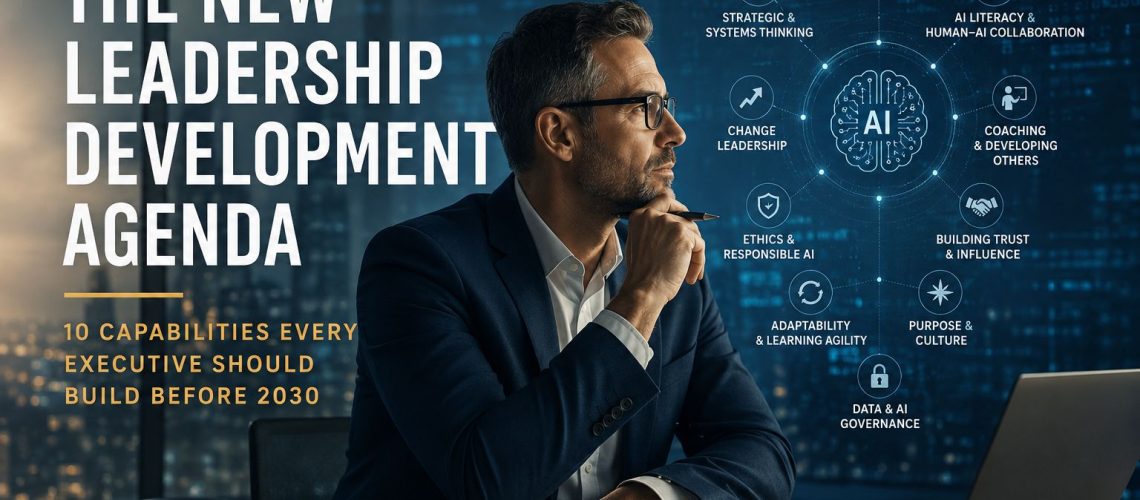
By 2030, the most effective executives are likely to be those who can:
- Exercise sound judgement
- Think strategically and systemically
- Design productive human–AI collaboration
- Interpret uncertainty
- Lead continual change
- Develop human capability
- Build trust and legitimacy
- Govern AI responsibly
- Learn and adapt
- Align technology with organisational purpose and culture
Leadership development must therefore move beyond expanding what executives know. It must develop the human, relational and organisational capabilities through which increasingly powerful technologies are directed towards responsible and sustainable value.
AI can expand what an organisation is capable of doing. Leadership determines what it should do, how it should do it and who remains accountable for the consequences.
References
- Batool, A., Zowghi, D., & Bano, M. (2025). AI governance: A systematic literature review. AI and Ethics, 5, 3265–3279. https://doi.org/10.1007/s43681-024-00653-w
- Berente, N., Gu, B., Recker, J., & Santhanam, R. (2021). Managing artificial intelligence. MIS Quarterly, 45(3), 1433–1450. https://doi.org/10.25300/MISQ/2021/16274
- Bevilacqua, S., Ferraris, A., Matzler, K., & Kuděj, M. (2026). Strategic leadership at high altitude: Investigating how AI affects the required skills of top managers. Journal of Business Research, 205, Article 115878. https://doi.org/10.1016/j.jbusres.2025.115878
- Brynjolfsson, E., Li, D., & Raymond, L. R. (2025). Generative AI at work. The Quarterly Journal of Economics, 140(2), 889–942. https://doi.org/10.1093/qje/qjae044
- Dell’Acqua, F., McFowland, E., Mollick, E. R., Lifshitz-Assaf, H., Kellogg, K. C., Rajendran, S., Krayer, L., Candelon, F., & Lakhani, K. R. (2026). Navigating the jagged technological frontier: Field experimental evidence of the effects of artificial intelligence on knowledge worker productivity and quality. Organization Science, 37(2). https://doi.org/10.1287/orsc.2025.21838
- Glikson, E., & Woolley, A. W. (2020). Human trust in artificial intelligence: Review of empirical research. Academy of Management Annals, 14(2), 627–660. https://doi.org/10.5465/annals.2018.0057
- Kellogg, K. C., Valentine, M. A., & Christin, A. (2020). Algorithms at work: The new contested terrain of control. Academy of Management Annals, 14(1), 366–410. https://doi.org/10.5465/annals.2018.0174
- Papagiannidis, E., Mikalef, P., & Conboy, K. (2025). Responsible artificial intelligence governance: A review and research framework. The Journal of Strategic Information Systems, 34(2), Article 101885. https://doi.org/10.1016/j.jsis.2024.101885
- Raisch, S., & Krakowski, S. (2021). Artificial intelligence and management: The automation–augmentation paradox. Academy of Management Review, 46(1), 192–210. https://doi.org/10.5465/amr.2018.0072
- Vaccaro, M., Almaatouq, A., & Malone, T. W. (2024). When combinations of humans and AI are useful: A systematic review and meta-analysis. Nature Human Behaviour, 8, 2293–2303. https://doi.org/10.1038/s41562-024-02024-1
- Wu, S., Liu, Y., Ruan, M., Chen, S., & Xie, X.-Y. (2025). Human–generative AI collaboration enhances task performance but undermines human intrinsic motivation. Scientific Reports, 15, Article 15105. https://doi.org/10.1038/s41598-025-98385-2