

Senior leaders are expected to make sound decisions, deliver results, manage complex relationships and lead through uncertainty. In South Africa’s challenging business environment, effective executive leadership requires more than technical expertise.
Executive coaching provides a structured, confidential environment where leaders can challenge their thinking, strengthen their leadership skills and develop more effective approaches to managing people and business challenges.
Working with a professional leadership coach helps executives become more self-aware, improve their judgement and strengthen their leadership capability across increasingly demanding leadership roles.
How Does Executive Coaching Improve Leadership Performance?
Effective leadership development starts with clear coaching goals connected to business priorities.
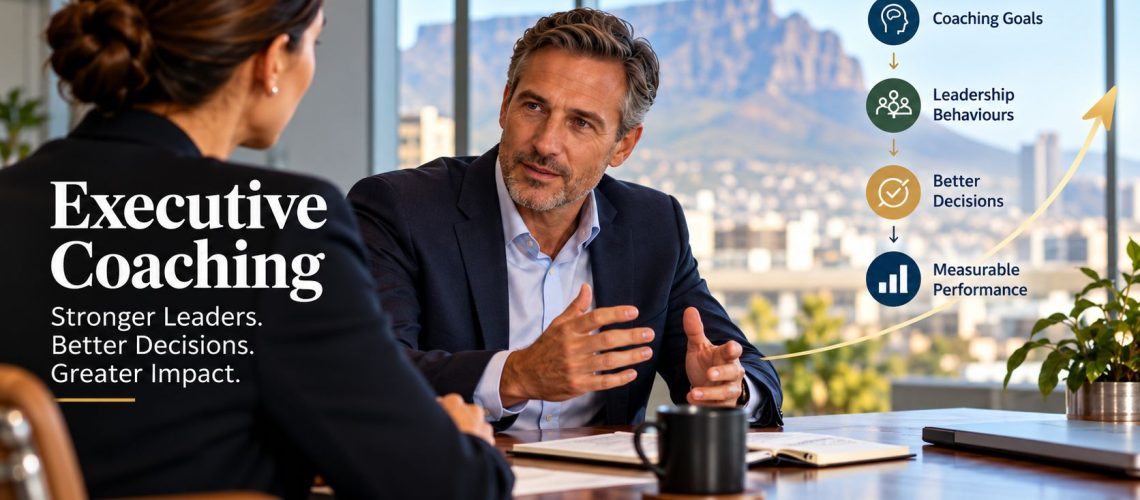
The relationship between coaching and performance follows a practical progression:
Coaching Goals → Leadership Behaviours → Better Decisions → Measurable Performance
For example, an executive who wants to improve delegation may use a coaching session to examine existing management habits, identify barriers to empowerment and develop more effective ways of assigning responsibility.
Improved delegation can strengthen accountability within the leadership team, reduce unnecessary escalation and allow senior leaders to focus on strategic priorities.
The objective is not simply to develop better leadership skills, but to translate personal development into observable improvements in leadership effectiveness and business performance.
Practical Examples of Executive Coaching
Executive coaching can address different challenges depending on the leader’s responsibilities and development needs.
Executives: A CEO navigating strategic change may work with a leadership coach to challenge assumptions, evaluate competing priorities and strengthen decision-making. Progress could be reviewed through strategic alignment, decision quality and execution milestones.
Senior managers: A manager experiencing communication or delegation difficulties may focus on providing constructive feedback, empowering employees and improving team accountability. Relevant indicators include delivery reliability, fewer unnecessary escalations and team feedback.
HR sponsors: An HR leader supporting a newly appointed executive may establish coaching goals linked to leadership capability, stakeholder relationships and organisational effectiveness. Progress can be reviewed through agreed behavioural indicators and appropriate stakeholder feedback.
These examples illustrate possible coaching applications rather than actual client results.
When Is Executive Coaching Appropriate?
Executive coaching is particularly valuable when leaders:
Transition into new or more demanding leadership roles.
Face complex decisions or significant organisational change.
Need to strengthen relationships within their leadership team.
Want to improve communication, delegation or conflict management.
Seek to develop their executive leadership capability and prepare for future responsibilities.
Coaching is not only for leaders experiencing difficulties. It also supports experienced executives who want to challenge established thinking patterns, develop greater self-awareness and enhance their leadership impact.
However, coaching should not replace formal performance management or interventions required to address structural organisational problems.
How Can Executive Coaching Progress Be Measured?
Coaching effectiveness should be evaluated against clearly defined objectives established at the beginning of the engagement.
A practical approach includes identifying the leadership behaviours that need to change, establishing a baseline and reviewing progress throughout the coaching process.
Performance indicators may include:
Improvements in leadership behaviour and stakeholder feedback.
Greater decision-making effectiveness.
Stronger communication and team accountability.
Progress against agreed business objectives.
Regular reviews help leaders recognise development, identify remaining challenges and sustain improvements.
The key question is not only what the leader has learnt, but what they now do differently and how that contributes to performance.
Business outcomes are influenced by multiple factors, so reviews should avoid attributing every performance improvement directly to coaching. Confidentiality must also be respected.
Strengthen Your Executive Leadership with ECCSA
At Esterhuizen Coaching and Consulting (ECCSA), we believe effective coaching should increase a leader’s capacity to think, decide and act independently.
Our approach connects self-awareness, intentional leadership, practical behavioural change and measurable development goals.
Through our Executive Coaching Services, we help senior leaders strengthen their leadership capability, navigate complexity and unlock their full potential.
Our Management Consulting Services complement this development by helping organisations address strategic, operational and organisational challenges.
Together, coaching and consulting can help align individual leadership development with broader business priorities.
Ready to strengthen your leadership performance?
Explore ECCSA’s Coaching Services and discover how purposeful leadership development can support more effective decisions, stronger teams and sustainable performance.
ECCSA – Connecting people to purpose.