
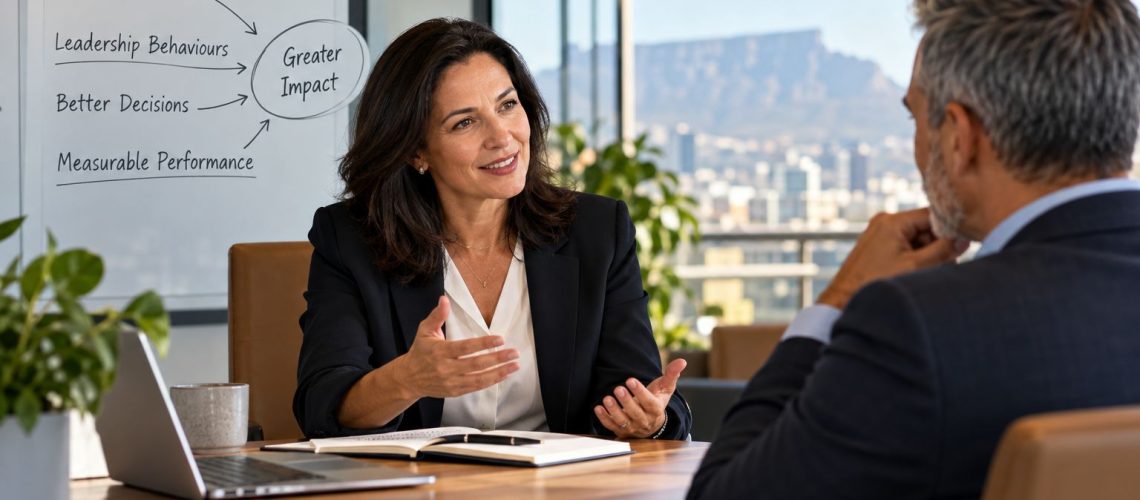

Senior leaders face complex decisions, demanding performance expectations and constant change. Yet, as leaders progress within an organisation, opportunities for honest reflection and constructive challenge can become limited.
Executive coaching provides a confidential, structured partnership that helps CEOs, executives and senior managers strengthen leadership behaviours, improve decision-making and achieve meaningful development goals.
What Does Executive Coaching Involve?
Executive coaching is a collaborative leadership development process that connects personal insight with practical workplace action.
A typical engagement involves identifying leadership challenges, establishing coaching goals, exploring behavioural patterns and developing more effective approaches to leadership.
Psychometric assessments and 360-degree feedback may also be incorporated to strengthen self-awareness and identify development opportunities.
When Is Executive Coaching Appropriate?
Executive coaching is particularly valuable when leaders are:
- Transitioning into senior leadership or executive positions.
- Navigating organisational change, uncertainty or strategic challenges.
- Seeking to improve communication, delegation and stakeholder relationships.
- Preparing for succession or greater leadership responsibilities.
- Looking to strengthen self-awareness, resilience and decision-making.
Coaching supports both experienced leaders seeking further growth and those addressing specific development challenges. However, it cannot replace specialist psychological support or management action where these are needed.
How Does Coaching Translate into Measurable Performance?
Effective executive coaching connects coaching goals, leadership behaviours, decisions and measurable performance.
Coaching goals identify what needs to develop. Changes in leadership behaviour influence how leaders communicate, delegate and make decisions. These changes can contribute to stronger team effectiveness and organisational performance.
Consider three practical examples:
For executives: A CEO seeking to improve strategic delegation might focus on empowering the executive team, clarifying decision-making authority and prioritising strategic responsibilities. Progress could be measured through decision turnaround times and accountability for agreed objectives.
For senior managers: A manager experiencing team performance challenges might focus on constructive feedback, difficult conversations and clearer expectations. Progress could be assessed through stakeholder feedback, team accountability and delivery against targets.
For HR sponsors: An HR leader sponsoring executive coaching might establish development objectives linked to succession readiness or leadership capability. Progress could be reviewed through behavioural indicators, stakeholder feedback and development milestones, while respecting coaching confidentiality.
These are illustrative examples, not claims about client results.
How Is Coaching Progress Reviewed?
Coaching effectiveness should be assessed against goals established at the beginning of the engagement.
Progress reviews may include initial behavioural assessments, agreed development milestones, stakeholder feedback and relevant performance indicators.
Regular reviews help leaders recognise behavioural changes, evaluate decisions and identify areas requiring further attention.
Although business improvements cannot always be attributed directly to coaching, clearly defined measures provide a practical basis for evaluating development progress.
Why Does Executive Coaching Matter in South Africa?
South African leaders operate in an environment influenced by economic uncertainty, workforce diversity, transformation and technological change.
Effective leadership requires adaptability, emotional intelligence, sound judgement and the ability to align people around shared objectives.
Executive coaching helps leaders develop these capabilities while responding to the specific challenges facing their organisation.
Executive Coaching with ECCSA
At Esterhuizen Coaching and Consulting (ECCSA), our Coaching for Growth approach focuses on developing self-awareness, strengthening leadership capability and translating insights into meaningful action.
Our philosophy is simple: Know yourself. Grow yourself.
Leadership development does not happen in isolation. Individual effectiveness must also be considered within the wider business context.
Explore our Executive Coaching Services, discover our broader Coaching Services or learn how our Consulting Services support sustainable change and business improvement.
Ready to strengthen your leadership effectiveness?
Connect with ECCSA to discuss how executive coaching can support your leadership development and performance goals.