
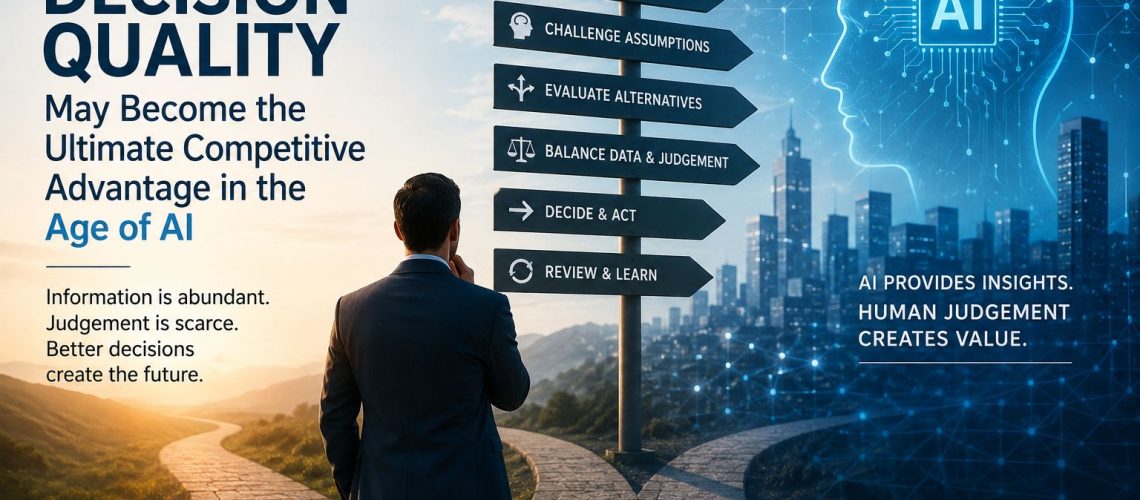

Why Decision Quality May Become the Ultimate Competitive Advantage in the Age of AI
Artificial Intelligence is transforming how organisations access information, analyse data, generate insights and automate work. As AI capabilities continue to advance, information is becoming increasingly abundant and accessible.
This creates an important shift.
Historically, organisations often gained an advantage through superior access to information, expertise or specialised knowledge. Today, many of those advantages are becoming more widely available through AI-enabled tools and platforms.
As information becomes more accessible, organisations may find that competitive advantage depends less on access to information and more on the ability to exercise sound judgement and make effective decisions.
The challenge is that AI does not eliminate the need for human decision-making. In many cases, it increases it.
AI can generate options, identify patterns and provide recommendations. However, leaders must still determine which questions to ask, what information to trust, how to interpret results, what risks to consider and which actions to take. Ultimately, accountability for decisions remains a human responsibility.
This means that organisations must develop capabilities that extend beyond technology. Critical thinking, judgement, decision-making, leadership, collaboration and governance become increasingly important in an environment where information is abundant, but certainty remains elusive.
Research and management practice consistently show that effective decision-making requires challenging assumptions, evaluating alternatives, seeking diverse perspectives, balancing data with experience and learning from outcomes. These capabilities become even more important when AI is involved.
Perhaps the most significant implication is that AI amplifies both good and bad decision-making.
Organisations with strong leadership, sound governance and effective decision-making processes are likely to derive greater value from AI. Organisations with weak decision-making practices may simply make poor decisions faster and on a greater scale.
At ECCSA, we believe that building future capability is ultimately about strengthening the ability of individuals, leaders, teams, workforces and organisations to make better decisions and take effective action. Better decisions improve performance, increase adaptability and contribute to sustainable value creation.
As Peter Drucker famously observed:
“Whenever you see a successful business, someone once made a courageous decision.”
AI is making information easier to access, analyse and distribute. Information alone, however, does not create value. Value is created when individuals, teams and organisations use information to make sound decisions and act effectively.
As AI continues to evolve, the organisations that succeed may not be those with the most technology, but those that develop the strongest capability for judgement, decision-making and execution.
In a world where intelligence is becoming increasingly available, decision quality may become one of the most important differentiators of organisational success.