
Developing Mental Toughness: Build Resilience, Strength, and Confidence
Become Mentally Stronger – Build Your Mental Toughness Today
Developing mental toughness empowers you to build lasting resilience and succeed in every area of life, both personally and professionally, as well as in leadership roles.
What is Mental Toughness?
Mental toughness is the capacity to deal effectively with stress, pressure, and challenge—and still perform at your best, regardless of the situation.
It is a core personality trait that largely determines how people respond to adversity, uncertainty, and high expectations.
As defined by Clough & Earle (2002), it is “the capacity for an individual to deal effectively with stressors, pressures and challenges and perform to the best of their abilities, irrespective of the circumstances in which they find themselves.”
Further developed by Clough & Strycharczyk (2012), it is seen as “a personality trait which determines, in large part, how people respond to challenge, stress and pressure, irrespective of their circumstances.”
Whether you’re a leader, professional, athlete, or student, developing mental toughness equips you to stay focused, resilient, and confident, even when the pressure is on.
“Mental toughness is not about being unaffected by challenges – it’s about thriving because of them.”
The Mental Toughness Model
The 4C Mental Toughness model shown in the picture below was developed by Clough & Strycharczyk. By completing the Mental Toughness Questionnaire (MTQ+), each of the 4Cs and their two underlying factors are measured.
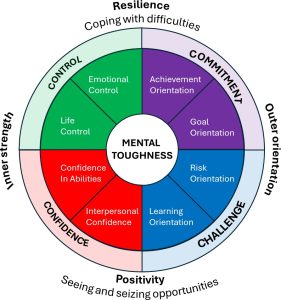
The 4Cs in the MTQ+ model represent four key components of mental toughness:
- Control: This refers to the extent to which individuals feel they can control their environment and influence outcomes. It encompasses emotional control and life control, indicating a person’s ability to manage their emotions and feel in control of their life.
- Commitment: This is the ability to set goals and consistently work towards achieving them. It reflects determination and the capacity to persist in tasks despite difficulties or challenges.
- Challenge: This component measures how individuals perceive challenges and change. Those with high challenge scores see challenges as opportunities for personal growth and development, rather than as threats.
- Confidence: This encompasses self-belief and interpersonal confidence. It reflects how much individuals believe in their abilities and how confident they are when interacting with others.
Why Mental Strength and Resilience Matter
Being mentally strong allows you to:
- Bounce back from setbacks
- Make better decisions under stress
- Stay motivated and committed
- Handle pressure in leadership and personal life
- Navigate change and uncertainty with confidence
Developing mental toughness and resilience leads to higher performance, greater wellbeing, and improved leadership.
How to Build Mental Toughness and Mental Strength
We use proven, evidence-based tools (like the MTQ Plus assessment) to help individuals and teams become mentally tough. Here’s how:
1. Mental Toughness Assessment
Identify your current levels of control, commitment, challenge, and confidence.
2. Personalised Coaching
Learn mental toughness exercises, mindset strategies, and habits for resilience.
3. Ongoing Development
Build new habits to improve your mental strength and stay mentally tough in the long run.

Practical Tips and Mental Toughness Exercises
- Practice visualisation and self-talk techniques
- Set small, measurable goals and commit to them
- Learn to reframe failure as feedback
- Build emotional control through mindfulness
- Increase confidence by tracking small wins
Building Mental Resilience Takes Practice – But It’s Worth It
Who Should Build Mental Toughness?
- Business Leaders and Entrepreneurs
- Athletes and Performers
- Students and Young Professionals
- Teams in High-Stress Environments
- Anyone Seeking Mental and Emotional Resilience