

Business is Like Riding Off-Road: How Mental Toughness (MTQ+) Keeps You on Track
When I first wrote about how riding a motorcycle off-road mirrors the realities of running a business, I focused on lessons from the trail, keeping your eyes on the destination, committing to momentum, and adapting to terrain that changes without warning.
Since then, I’ve found another lens that deepens this analogy: MTQ+, the Mental Toughness model developed by Professor Peter Clough and Doug Strycharczyk. The more I reflected, the more I realised that off-road riding is mental toughness in action.
What is Mental Toughness?
According to Strycharczyk and Clough, mental toughness is “a personality trait that determines, in large part, how people respond to challenge, stress and pressure, irrespective of their circumstances.”
It is measurable, developable, and essential for consistent performance in business, sport, and life.
Mental resilience is closely related; it’s the ability to recover quickly from setbacks. While resilience focuses on “bouncing back,” mental toughness also includes the proactive, positive mindset that helps you thrive under pressure, not just survive.
Mental Toughness vs Mental Strength
Although the terms are often used interchangeably, they are not the same.
- Mental strength generally refers to willpower, discipline, and the ability to endure discomfort or delay gratification.
- Mental toughness, as defined by MTQ+, is broader; it includes mental strength plus confidence, adaptability, emotional control, and a growth mindset under pressure.
You can be mentally strong in a short-term challenge yet still lack mental toughness for sustained, unpredictable demands, just as a rider can muscle through one rough patch but struggle to adapt when the terrain keeps changing.
The Four Core Elements of Mental Toughness (MTQ+)
MTQ+ breaks mental toughness into four key areas: Control, Commitment, Challenge, and Confidence, each with two subscales. Let’s take these factors for a ride through the dirt tracks of off-road motorcycling and see how they apply in business.
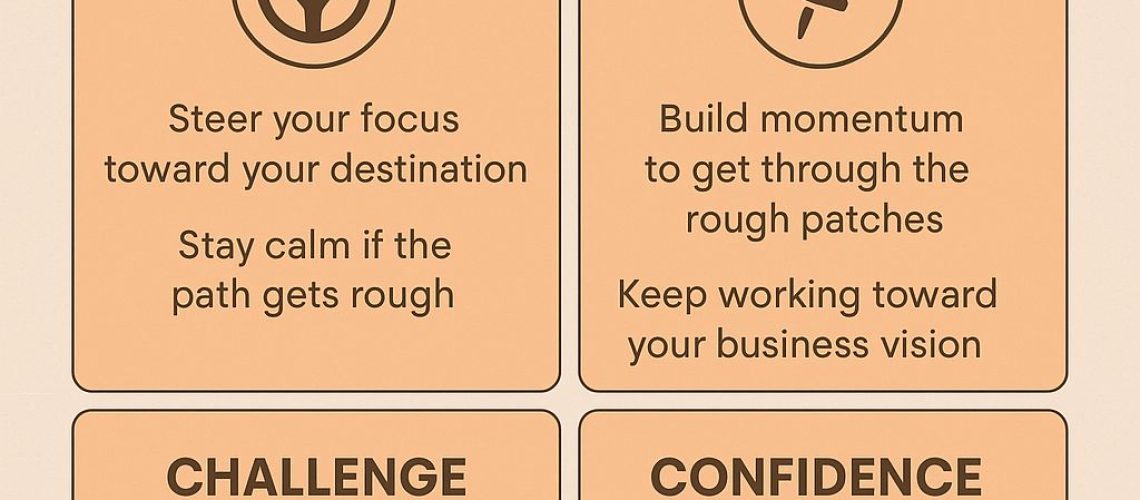
1. Control – Steering Your Own Path
On the bike, the instructor says: “Look where you want to go.” Focus on the rocks and you’ll end up in them.
- Life Control – Believing you can shape outcomes. In business, this is keeping eyes on your vision, even when the environment is uncertain.
- Emotional Control – Staying calm in the sand, trusting the bike to self-correct. Leaders demonstrate this when they stay composed in crises rather than micromanaging.
Business takeaway:
- Keep your focus on your destination, not on distractions.
- Manage your reactions; the “loosen your grip” principle applies both in sand and in staff leadership.
2. Commitment – Momentum Gets You Through the Rough Patches
In off-road riding, momentum is your best ally in tough terrain. Slow down too much in deep sand, and you’ll sink.
- Goal Orientation – Setting clear targets.
- Achievement Orientation – Persisting until the finish line, even if the track changes.
Business takeaway:
- Commit to your goals and follow through despite short-term discomfort.
- Align your team’s “why” with your business purpose to maintain motivation.
3. Challenge – Embracing the Unpredictable
Off-road tracks never stay the same. Rocks shift, dust thickens, ruts deepen, just like the market changes.
- Risk Orientation – Seeing uncertainty as an opportunity rather than a threat.
- Learning Orientation – Treating every obstacle as feedback for improvement.
Business takeaway:
- Train your team to adapt quickly.
- Recognise that some solutions are counter-intuitive, like accelerating over loose gravel instead of braking.
4. Confidence – Trusting Your Skills and Your Crew
In riding, confidence means trusting your technique when the track gets tricky.
- Confidence in Abilities – Backing your skills under pressure.
- Interpersonal Confidence – Believing you can influence and collaborate effectively.
Business takeaway:
- Have faith in your own competence.
- Empower your people to make decisions and take ownership.
Building Mental Toughness in Business
You can develop mental toughness the same way you improve off-road riding skills through purposeful training, experience, and reflection.
Practical steps include:
-
Clarify your purpose – Know why you’re in the “race” before you start.
-
Set and commit to goals – Define your horizon and keep your eyes on it.
-
Simulate challenges – Practise handling pressure in lower-risk situations.
-
Reflect and adapt – Treat every setback as a learning opportunity.
-
Build mental fortitude through habits – Mindfulness, recovery routines, and feedback loops strengthen performance under stress.
Going Slow to Go Fast
In extreme enduro, riders often help each other over obstacles. In business, building mental toughness sometimes means slowing down to bring others with you because sustainable success is a team sport.
From the Dirt Track to the Boardroom
Both business and off-road riding demand:
- Focused vision (Control)
- Consistent action (Commitment)
- Embracing change (Challenge)
- Self-belief (Confidence)
When you build mental toughness, you develop the mental fortitude to steer through uncertainty, maintain momentum over obstacles, and seize opportunities hidden in the rough terrain.
So next time your business hits a patch of sand, remember:
- Keep your head up.
- Commit to the ride.
- Embrace the challenge.
- Trust your abilities and your team.
Because in both business and off-road riding, the goal isn’t just to finish, it’s to ride with purpose, resilience, and the skills to handle whatever the trail throws your way.