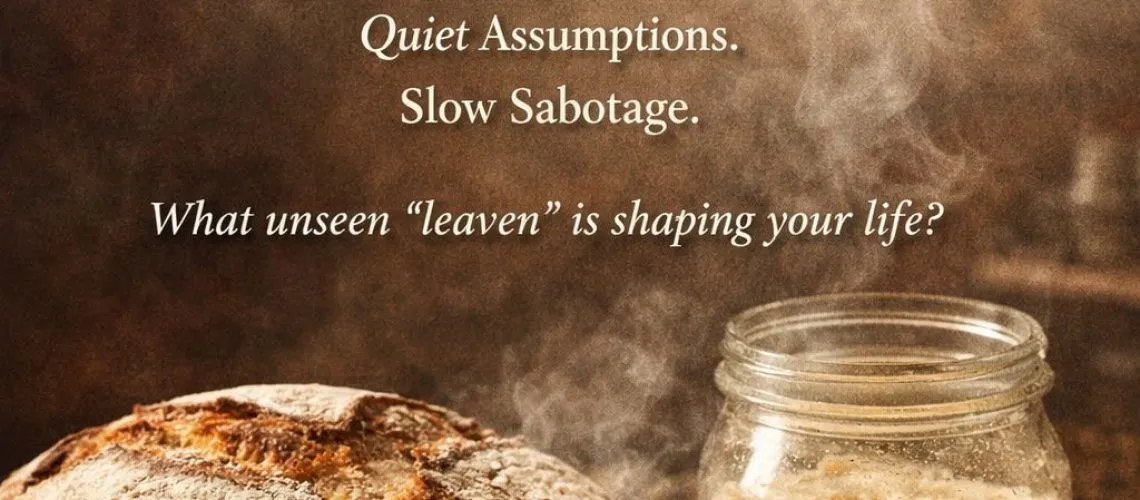

Last week I was baking bread.
I use a sourdough starter, and for some reason, the dough simply would not rise. I checked the temperature. I checked the flour. I adjusted the water. Still, nothing much happened.
And then I started thinking about the starter itself.
Yeast does not shout. It does not announce itself. It works quietly, invisibly, slowly transforming the entire mixture. If it is weak, the loaf struggles. If it is active, everything changes.
That was the moment I realised something uncomfortable.
We sabotage ourselves in exactly the same way.
Not dramatically. Not loudly. Not in one catastrophic decision.
But slowly, through the silent “leaven” of our beliefs.
What Is the Leaven?
In Mark 8, Jesus warns His disciples to “beware of the leaven.” They misunderstand Him. They think He is talking about bread. He is not.
Leaven represents influence, belief systems, and hidden assumptions that quietly permeate everything.
In Enneagram language, leaven is the unconscious core belief that shapes how we interpret the world.
- It is not behaviour.
- It is not personality quirks.
- It is the silent assumption underneath everything.
And unless we become aware of it, it shapes the whole loaf of our life.
The Silent Leaven: “Hidden Beliefs” of Enneagram Types
Every Enneagram type has a particular “starter” running in the background.
Type One – The Leaven of Moral Perfection
“There is a right way, and I must uphold it.”
- This belief produces integrity, reform, and high standards.
- But it can also create tension, self-criticism, and frustration with others.
- When the leaven hardens, nothing is ever good enough.
Type Two – The Leaven of Indispensability
“I must be needed to be loved.”
- This belief produces warmth and generosity.
- But it can blur boundaries and silence personal needs.
- Sabotage occurs when worth becomes tied to usefulness.
Type Three – The Leaven of Performance
“I am what I accomplish.”
- This belief drives excellence and results.
- But it can disconnect identity from authenticity.
- When achievement becomes oxygen, rest feels dangerous.
Type Four – The Leaven of Deficiency
“Something is missing in me.”
- This belief deepens emotional awareness and creativity.
- But it can amplify comparison and longing.
- The sabotage is subtle, constantly scanning for what is absent instead of what is present.
Type Five – The Leaven of Scarcity
“Resources are limited, I must conserve.”
- This belief produces insight and mastery.
- But it can restrict engagement and emotional investment.
- The hidden fear is that giving too much will lead to depletion.
Type Six – The Leaven of Threat
“Something could go wrong.”
- This belief strengthens vigilance and loyalty.
- But it can magnify doubt and anxiety.
- Safety becomes the organising principle of life.
Type Seven – The Leaven of Deprivation
“I must keep my options open or I will miss out.”
- This belief fuels enthusiasm and vision.
- But it can avoid discomfort and limit depth.
- The fear of being trapped keeps life wide but sometimes shallow.
Type Eight – The Leaven of Control
“If I do not take control, I will be controlled.”
- This belief produces courage and protection.
- But it can harden vulnerability.
- Strength becomes armour.
Type Nine – The Leaven of Disconnection
“My presence does not matter that much.”
- This belief fosters harmony and acceptance.
- But it can diminish voice and agency.
- Peace is preserved, sometimes at the cost of self.
How We Slowly Sabotage Ourselves
None of these beliefs begins as sabotage.
They begin as survival strategies.
At some point in life, that leaven helped us cope. It helped us belong. It helped us succeed. It helped us stay safe.
But when it becomes unconscious and unquestioned, it expands quietly into every decision, every reaction, every relationship.
- We stop seeing clearly.
- We interpret neutral situations through old lenses.
- We react to imagined threats.
- We strive for goals that never satisfy.
And like my stubborn loaf of bread, we wonder why we are not rising.
The Invitation
The goal is not to remove the leaven.
It is to become aware of it.
Sourdough works best when the starter is alive, balanced, and intentionally cultivated. The same is true for us.
Self-awareness does not eliminate personality.
It transforms it.
When we recognise our silent assumptions, we gain choice.
- We can pause before reacting.
- We can question the belief.
- We can respond differently.
And slowly, the loaf begins to rise.
So here is a question for reflection:
What silent “leaven” might be shaping your thinking right now?
- Not your behaviour.
- Not your image.
- But the quiet belief underneath it all.
Because transformation rarely begins with dramatic change.
It begins with noticing what has been quietly shaping us all along.