
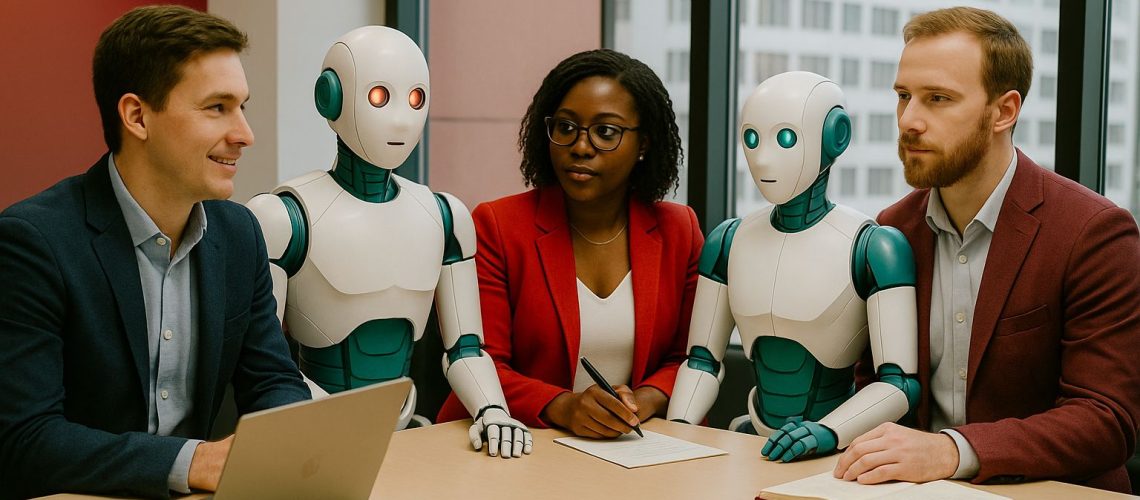

The future of work is shifting at a speed we have never experienced before. As artificial intelligence moves beyond simple digital functions and becomes a competent, interactive partner in daily operations, the nature of every job role is evolving. Around the world, the organisations gaining the most value from this transformation are what economists call frontier firms. These businesses adopt new technologies early and integrate them deeply into strategy, operations, and everyday work. As organisations accelerate their shift toward intelligent automation, many are following a similar trajectory, treating AI as a strategic capability rather than a technical add-on.
These firms are already redesigning roles, reshaping workflows, and building the human capabilities needed to supervise and collaborate with intelligent systems. Modern organisations are entering an era of AI in which intelligent agents, digital reasoning engines, and automated workflows will be part of everyday operations. This means every employee, regardless of title, will increasingly understand how to direct, supervise, and collaborate with AI agents as part of their everyday workflow.
Advancements in AI technologies, AI models, generative AI, and structured AI system design are enabling employees to use AI tools with more sophistication than ever before. Instead of replacing people, AI is transforming how work gets done, elevating the skills required, and redefining what a meaningful and valuable employee experience looks like in organisations that embrace AI. The question is no longer whether we will use AI, but how well we will manage it.
Why AI in the Workspace Is Transforming Roles and Value
AI has moved from being a standalone resource to becoming an integrated collaborator in the flow of work. Many organisations have discovered that AI can perform tasks that once required deep human concentration, such as conducting research, synthesising information, producing content, assessing data, and proposing next steps. This shift allows AI to serve as an assistant, analyst, advisor, and project coordinator simultaneously.
Because of this, the ability to manage and guide AI is becoming a core competency across industries. In an environment of rapid AI adoption, employees no longer interact with AI as a passive tool but as a digital partner who contributes to productivity, quality, and insight. Using AI application logic, these systems understand context, adapt to objectives, and respond to feedback, accelerating delivery. The new challenge is learning how to oversee this collaboration with clarity, intention, and decisive judgment.
What It Means to Use AI as a Manager Rather Than a Tool
Managing AI is fundamentally different from merely using it. When employees shift from issuing simple instructions to engaging AI as they would a junior colleague, the nature of the relationship changes. Employees must articulate expectations more clearly, define scope with precision, set measurable outputs, and review work with a discerning eye. They must also refine, correct, and iterate until the outcome meets the standard required.
This shift requires a much deeper understanding of how AI operates and what it needs to function optimally. Instead of completing all tasks manually, individuals will increasingly distribute responsibilities between themselves and intelligent systems, orchestrating workflows and evaluating performance. Those who excel in this will become leaders in the future of AI-powered workplaces.
Core Skills Required in the AI-Enabled Workplace
1. AI Literacy and Digital Fluency
Employees must develop a confident understanding of how AI operates. This includes recognising what AI can do independently, where it requires human oversight, and when it may produce uncertainty or error. Digital fluency also requires an understanding of how information flows into and out of AI systems, why specific outputs are created, and how these outputs should be validated before further action is taken. This foundation allows employees to use AI intentionally rather than hesitantly.
2. Prompt Engineering and Task Orchestration
Prompting is emerging as one of the most important communication skills of the decade. It requires employees to think clearly, write precisely, and design instructions that guide AI to deliver meaningful outcomes. Effective prompting includes providing context, describing constraints, defining success criteria, and breaking complex tasks into manageable phases. It also requires employees to iterate and refine AI outputs until they achieve the desired result. This transforms prompting into a skill of orchestration, shaping how tasks unfold in collaboration with intelligent agents.
3. Data Competence and Decision Intelligence
AI accelerates access to information, but human judgment remains essential. Employees must learn to interpret AI-generated insights with a critical mind, understanding the underlying data, identifying gaps, and determining the reliability of conclusions. Decision intelligence means knowing when to trust the AI’s recommendations and when deeper review is needed. It also involves combining AI insights with human experience, contextual knowledge, and strategic thinking to produce decisions that are both informed and responsible.
4. Critical Thinking and Cognitive Oversight
AI systems, while powerful, are not infallible. They require human oversight to ensure that outputs are accurate, relevant, and aligned to organisational needs. Employees must learn to evaluate AI responses through a lens of critical thinking, questioning assumptions, identifying inconsistencies, uncovering bias, and exploring alternative perspectives. This type of oversight protects organisational integrity and ensures that the partnership between humans and technology results in high-quality decisions.
5. Ethical, Safe, and Compliant Use of AI
As AI becomes embedded in the flow of work, the risks associated with poor governance increase. Employees need to understand the ethical implications of AI, including how to handle sensitive information, preserve privacy, and address bias. They must also comply with corporate policies, safeguards, and POPIA requirements to ensure responsible use. Ethical competence is no longer optional; it is a core organisational value and a driver of long-term trust.
6. Workflow Design and Automation Thinking
Moving into AI-enabled environments requires employees to shift from doing work to designing how work is done. Workflow design involves identifying opportunities for automation, integrating AI agents into processes, coordinating steps across teams, and ensuring that quality checks are in place. Employees who understand workflow dynamics will be able to create processes that are faster, more reliable, and more aligned with organisational strategy.
7. Systems Thinking and Strategic Oversight
AI does not operate in isolation. It operates within a broader organisational ecosystem comprising people, processes, technology, and culture. Employees must develop the ability to connect these elements and anticipate how changes in one area affect the others. Systems thinking enables individuals to evaluate downstream consequences, enhance cross-functional collaboration, and design solutions that support long-term sustainability. Strategic oversight also ensures that AI aligns with business objectives rather than just operational convenience.
8. Human Centric Leadership and Adaptability
With rapid technological progress comes the need for emotional intelligence, clear communication, and an open-minded approach to experimentation. Employees must be able to support colleagues as they adapt to new ways of working, foster psychological safety, and embrace continuous learning. Human-centric leadership emphasises empathy, collaboration, and creativity, ensuring that AI enhances human potential rather than overshadowing it.
How Organisations Can Use AI Effectively
To succeed in an AI-driven environment, organisations must create deliberate and strategic developmental pathways. This includes building awareness, providing structured skills training, establishing governance, and making space for experimentation. Businesses must also offer coaching and leadership development to ensure that employees are prepared to take on new responsibilities. By equipping people with the right mindset and capability, organisations can unlock the full potential of AI in the workplace and build workplaces that thrive in the era of intelligent automation.
Conclusion: Managing AI Is the Next Essential Human Capability
AI is reshaping every aspect of work, but it is not replacing the value humans bring. Instead, it amplifies human intelligence by providing speed, capacity, and insight. The future belongs to individuals who can collaborate effectively with AI agents, integrate them into systems, and make decisions with clarity and purpose. Those who embrace AI thoughtfully and develop these new competencies will not only stay relevant, they will become leaders in shaping the next generation of intelligent, human-centred work.