
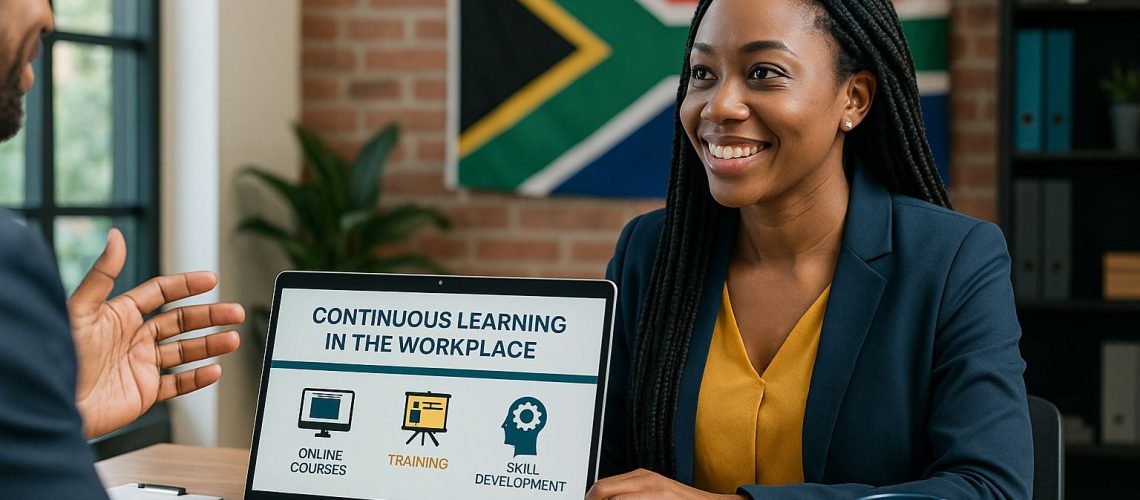

South Africa’s labour landscape is shifting rapidly due to digital transformation, hybrid work models and artificial intelligence. These changes require both organisations and employees to continuously update and learn new skills, expand their capabilities and adapt to evolving demands. Continuous learning in the workplace has therefore become essential for sustainable employability, organisational resilience and national competitiveness.
Research on leadership development and talent management in South Africa confirms that continuous learning supports professional development, adaptability and long-term employability. Global insights from the World Economic Forum show that employees who consistently build their knowledge and skills are more productive, engaged and resilient in uncertain environments.
Lifelong Learning and the Future Workplace: Why It Matters for South Africa
Technological change is accelerating, and artificial intelligence is transforming every major sector. These shifts require employees to acquire new capabilities, such as digital fluency, critical thinking, problem-solving, coding, and emotional intelligence.
South African research shows that leaders across sectors need stronger socio-emotional competencies, hybrid team capability and reflective practice. These competencies cannot be developed through one-off training events but through ongoing lifelong learning supported by real-world experience and reflection.
The World Economic Forum highlights adaptability, creativity and analytical thinking as essential future skills. Continuous learning builds these capabilities and equips employees to navigate uncertainty in a changing labour market.
The Benefits of Lifelong Learning for Organisations and Individuals
The benefits of lifelong learning are clear in both global and South African research. Continuous learning supports talent retention, leadership effectiveness, well-being and improved performance.
Organisations that prioritise learning and employee well-being can realise significant economic value. The WEF Thriving Workplaces report shows that investing in learning, growth, and holistic health can unlock between 3.7 and 11.7 trillion dollars in global productivity value.
South African leadership research further shows that a learning culture is linked to meaningful work, lower turnover intentions, and higher engagement. For employees, lifelong learning enhances personal development, confidence, career advancement and a stronger sense of identity and purpose.
Building a Culture of Continuous Learning in South African Workplaces
A strong learning culture is one of the most powerful drivers of performance and retention in South Africa. Such a culture values curiosity, growth and shared learning. It provides opportunities for learning experiences and supports both formal and informal learning pathways.
Informal learning, such as coaching, mentorship, reflective practice, and team-based problem-solving, plays a vital role in South Africa due to resource constraints across many sectors. It is also one of the strongest drivers of leadership behaviour change.
The WEF Thriving Workplaces findings show that organisations with strong learning cultures experience reduced burnout, higher productivity and improved employee stability.
Learning Opportunities That Support Personal and Professional Growth
Future-ready organisations offer varied learning opportunities that support personal and professional growth. These opportunities include structured, digital, experiential and self-directed learning.
Structured Learning and Training Programs
Formal education, certificates and accredited training programs remain essential for deep expertise. However, South African research shows that structured learning alone is not sufficient for leadership development, especially in complex hybrid environments.
Blended Learning and Online Learning
Blended learning, which combines face-to-face sessions with digital modules, supports accessibility and flexibility. Online learning platforms, online courses and modern learning management systems expand employee access to new knowledge and skill development.
South African research notes that digital learning helps close capability gaps but must be supported with mentorship and real-world application to ensure behavioural change.
Informal, Social and Self-Directed Learning
Informal learning is the most impactful form of development across South African leadership contexts. Social learning through peer collaboration, communities of practice and mentorship strengthens problem-solving and interpersonal capability. Self-directed learning allows employees to take initiative, set personal learning goals and manage their own growth pathways.
Experiential Learning and On-the-Job Exposure
Experiential learning, such as stretch assignments, job rotations and acting roles, supports meaningful leadership development. Real work challenges create practical learning experiences that help employees apply new knowledge immediately. This is especially important in high-pressure sectors such as healthcare and government, where learning must occur in real time.
Why Effective Learning Is Essential for the South African Labour Market
South Africa faces severe skills shortages in healthcare, technology, education, digital services, analytics and leadership. Effective learning strategies are essential for building adaptive workforces who can respond to changing demands.
South African research highlights the need for leaders who can manage uncertainty, support teams in hybrid environments, and handle complexity. These competencies develop through continuous reflection, experiential learning and ongoing development practices.
The WEF Thriving Workplaces report also shows that employees with access to learning and development resources enjoy improved well-being, higher productivity and greater organisational stability.
How Individuals Can Strengthen Growth Through Self-Directed Learning
The research emphasises shared responsibility for learning. Professionals can strengthen their careers by engaging in self-directed learning and intentionally building their knowledge and skills.
Recommended actions include setting clear learning goals that support career development, using learning management systems and digital tools, combining diverse learning methods, seeking coaching and mentorship, and applying new knowledge to real-world challenges.
Individuals who take initiative build stronger personal and professional identities and become more confident, adaptable and future-ready.
How Organisations Can Support Upskilling and Employee Development
Organisations can support continuous learning by integrating learning into talent strategy, providing access to digital platforms, encouraging experimentation, and rewarding learning behaviour. Evidence-based continuous learning strategies include:
- Creating inclusive and psychologically safe environments
- Equipping managers to act as learning coaches
- Supporting blended learning and multiple development pathways
- Providing time and resources for learning
- Aligning learning with organisational goals
- Using data to track learning impact and employee outcomes
Research from both WEF and South African studies shows that organisations that invest in learning cultivate stronger leaders, improve employee development and build sustainable talent pipelines.
Conclusion: Continuous Learning Is South Africa’s Strategic Advantage
Continuous learning is essential for navigating technological change, economic uncertainty and evolving workplace expectations. It supports leadership capability, well-being, adaptability and national competitiveness. Research from South Africa and the World Economic Forum highlights that learning cultures create stronger organisations, healthier workplaces and more resilient employees.
South Africa’s future will be shaped by its commitment to continuous learning and by organisations and individuals who pursue growth with intention and purpose.
The future will belong to those who learn continuously and adapt confidently to an ever-changing world.
Reference list:
World Economic Forum. (2025). Thriving Workplaces: How Employers Can Improve Productivity and Change Lives. World Economic Forum, in collaboration with the McKinsey Health Institute. Retrieved from
World Economic Forum. (2025). Future of Jobs Report 2025. World Economic Forum. Retrieved from /mnt/data/WEF_Future_of_Jobs_Report_2025.pdf
[Author(s) Unspecified]. (2024). Impact of Continuous Learning Trends on Leadership Development and Talent Management in South Africa.